For many property owners in Santa Ana, concrete has been the default paving material for decades. Driveways, parking lots, and commercial surfaces were laid in concrete and expected to last. But as concrete ages, cracks, and deteriorates, property owners often face a significant decision: repair or replace the failing concrete with the same material, or convert the surface to asphalt? Over the past several decades, concrete to asphalt conversion has become an increasingly common choice for residential and commercial properties throughout Santa Ana. This article explores what Concrete To Asphalt Conversion Santa Ana involves, why property owners choose it, how the local environment influences the decision, and what the conversion process entails from start to finish.
What Is Concrete to Asphalt Conversion?
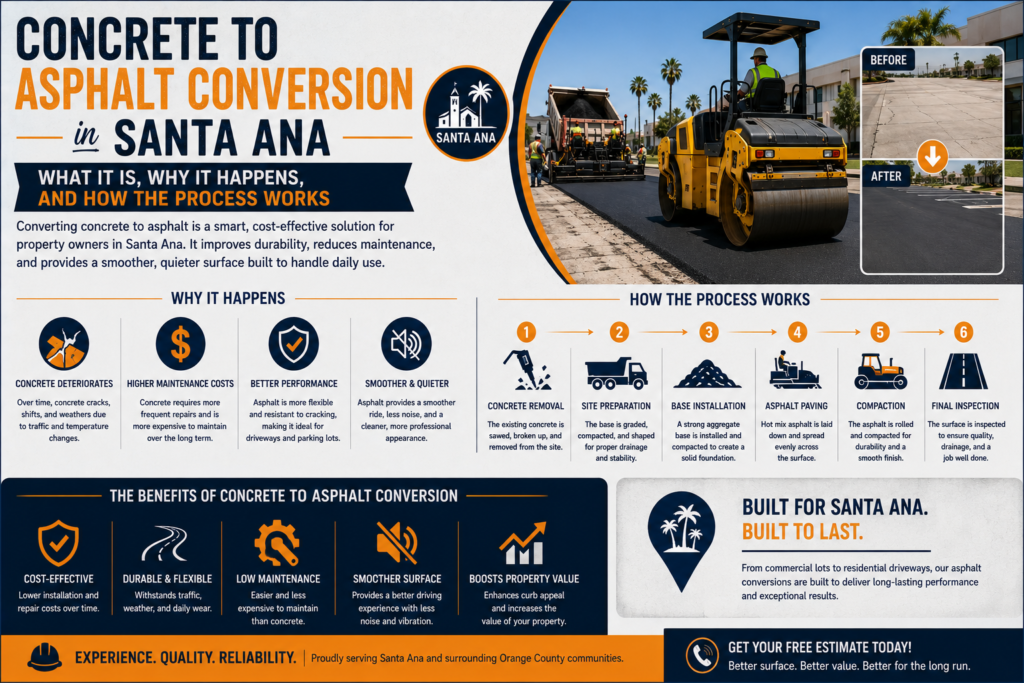
Concrete to asphalt conversion is the process of removing an existing concrete paved surface whether a driveway, parking lot, walkway, or other area and replacing it with an asphalt pavement. The old concrete is demolished and removed, the subbase is evaluated and prepared, and new hot-mix asphalt is installed in its place.
This is distinct from an asphalt overlay, in which a layer of asphalt is applied directly over existing concrete. While overlays are sometimes performed, a full conversion with removal of the existing concrete is generally preferred because it allows the contractor to evaluate and address subbase conditions, correct drainage issues, and achieve a more uniform finished surface level.
The decision to convert rather than replace with new concrete typically comes down to a combination of factors: the long-term performance characteristics of each material in the local climate, the relative ease of repair and maintenance, and the overall economics of the two options.
Why Do Property Owners in Santa Ana Convert Concrete to Asphalt?
Several factors make concrete to asphalt conversion a logical choice for many Santa Ana properties:
Flexibility Under Ground Movement: Santa Ana’s soil conditions particularly in areas with clay-heavy soils or proximity to the Santa Ana River basin are subject to expansion and contraction with seasonal moisture changes. Concrete is a rigid material and can crack or break when the ground beneath it moves. Asphalt is semi-flexible and can accommodate minor ground movement without fracturing, making it better suited to Santa Ana’s subsurface conditions.
Ease of Repair: When asphalt develops damage whether cracks, potholes, or surface degradation repairs are relatively straightforward. A damaged section can be removed and replaced, or the surface can be overlaid. Concrete repairs are more complex because patching material often does not bond well to existing concrete, and repair sections are visually conspicuous.
Temperature Management: Concrete, being lighter in color, reflects more heat but can experience significant thermal expansion and contraction. In Santa Ana’s climate, which includes warm summers and cooler winters, repeated thermal cycling over years contributes to concrete cracking. Asphalt’s flexibility means it handles these temperature cycles more gracefully.
Drainage Improvements: An older concrete surface that has settled unevenly may have drainage problems areas where water pools rather than draining away. A conversion project provides the opportunity to re-establish proper drainage grades across the entire surface.
Aging Concrete: Concrete driveways and parking lots in older Santa Ana neighborhoods may be 40, 50, or even 60 years old. At this age, the concrete may be deeply cracked, heavily stained, or structurally compromised beyond the point where repair makes economic sense. Conversion to asphalt allows for a complete fresh start with a modern, well-installed surface.
Concrete vs. Asphalt: A Side-by-Side Comparison for Santa Ana Conditions
Understanding the differences between the two materials helps property owners make an informed conversion decision:
Durability and Lifespan: Both materials can provide 20 to 30 or more years of service when properly installed and maintained. Concrete generally has the longer theoretical lifespan, but in practice, the flexibility of asphalt in seismically active areas and locations with expansive soils often means fewer catastrophic failures.
Maintenance Requirements: Concrete requires less frequent routine maintenance but is more difficult and expensive to repair when significant damage occurs. Asphalt requires periodic sealcoating (every two to three years) and prompt crack repairs, but these tasks are relatively inexpensive and straightforward.
Installation Time: Asphalt can typically be laid and opened to traffic within 24 to 48 hours. Concrete requires a curing period of several days to a week before vehicle traffic is allowed.
Surface Temperature: Asphalt absorbs more heat than concrete, which means it can become hot to the touch in direct sunlight. In Santa Ana’s warm climate, this is a consideration for areas used by pedestrians or pets. Concrete stays cooler.
Appearance: Concrete offers more design versatility it can be stamped, colored, and finished in numerous ways. Asphalt is generally limited to its characteristic dark black surface, though its appearance can be refreshed with sealcoating.
Environmental Considerations: Modern asphalt has significant recyclability old asphalt is routinely recycled into new mixes, reducing waste. Some modern paving methods can reduce the carbon footprint of asphalt installation substantially compared to conventional techniques.
The Concrete to Asphalt Conversion Process
A quality conversion project in Santa Ana follows a systematic sequence of steps:
Site Assessment: The contractor evaluates the existing concrete surface, the subbase condition, drainage patterns, and any factors that contributed to the concrete’s deterioration. Understanding the root cause whether it is soil movement, poor drainage, tree root intrusion, or simply age informs how the new asphalt installation will be approached to avoid the same problems.
Concrete Demolition: The existing concrete is broken up using jackhammers, hydraulic breakers, or specialized pavement removal equipment. The material is loaded into trucks and hauled away.
Subbase Evaluation and Repair: With the concrete removed, the subbase is exposed and assessed. Soft spots, areas of poor compaction, or drainage issues are addressed at this stage. Additional aggregate base material may be added and compacted to bring the subgrade to the required specifications.
Grading: The surface is graded to establish the correct drainage slopes so that water runs away from structures and toward drains or street gutters. This step is critical poor grading is one of the most common causes of pavement problems.
Asphalt Installation: Hot-mix asphalt is delivered and laid using a paving machine. The asphalt is spread to the required thickness typically two to four inches for residential driveways and greater for commercial areas with heavier traffic then compacted with rollers.
Edging and Finishing: The perimeter of the paved area is defined and finished. Edges that are properly finished resist raveling and maintain the clean appearance of the surface.
Initial Curing: The new asphalt is left to cool and set before vehicle traffic is allowed. Foot traffic is generally possible within a few hours; vehicle traffic should wait 24 to 48 hours.
Concrete to Asphalt Conversion for Parking Lots in Santa Ana
Commercial parking lots represent one of the most common applications for concrete to asphalt conversion in Santa Ana. Many commercial properties were originally developed with concrete parking areas that, after decades of service, are showing extensive cracking, surface deterioration, and drainage problems.
For commercial property owners, the decision to convert is often driven by the recognition that maintaining a cracked, deteriorating concrete parking lot costs more over time in repairs, liability exposure, and customer impression than making the investment in a quality asphalt surface.
A converted asphalt parking lot also provides the opportunity to update the layout: restripe parking spaces to current ADA standards, add or improve handicapped accessible spaces, update curbing, and address drainage issues that may have developed over the decades.
It is worth noting that ADA compliance requires that any time a parking facility is altered which includes resurfacing the facility must be evaluated for ADA compliance with accessible parking spaces, access aisles, curb ramps, and accessible routes. A conversion project provides a natural opportunity to bring all these elements into compliance.
Maintaining a Newly Converted Asphalt Surface in Santa Ana
After a concrete to asphalt conversion, the new surface requires a different maintenance approach than concrete:
Initial Care: During the first weeks after installation, avoid sharp turns on the surface, as the asphalt is still developing its full hardness. Avoid heavy loads concentrated on small areas (like vehicle stands or heavy equipment) during this period.
Sealcoating: The first sealcoat should be applied approximately 90 days to one year after the initial installation, once the asphalt has fully cured. After that, sealcoating on a two-to-three-year cycle is recommended.
Crack Sealing: Address any developing cracks promptly with appropriate asphalt crack filler before water can infiltrate and weaken the base.
Periodic Inspection: Annual inspection of the surface and drainage allows early identification of developing issues before they become expensive problems.
Frequently Asked Questions About Concrete to Asphalt Conversion in Santa Ana
Is it possible to pave asphalt directly over existing concrete without removal? Yes, an asphalt overlay over concrete is technically possible in cases where the existing concrete is structurally sound and relatively flat. However, full removal and replacement is generally preferred because it provides the opportunity to correct subbase issues and drainage problems that the overlay approach cannot address.
Will the asphalt be at the same height as the surrounding surfaces? This depends on the thickness of the concrete being removed versus the thickness of the asphalt being installed. The contractor will account for these dimensions and, if necessary, make adjustments to maintain proper relationships with garage thresholds, adjacent walks, or street gutters.
How long will the converted asphalt surface last? With proper installation and regular maintenance including periodic sealcoating and prompt crack repair a converted asphalt surface in Santa Ana can last 20 to 25 years or more before requiring major rehabilitation.
Does a parking lot conversion require ADA updates? In most cases, yes. Any alteration to a parking facility, including resurfacing, triggers an obligation to evaluate the facility’s accessibility compliance and make required corrections to the accessible elements of the facility, such as accessible parking spaces and pedestrian routes.
Conclusion
Concrete to asphalt conversion in Santa Ana is a practical, well-established approach to renewing aging paved surfaces. For residential driveways whose original concrete has reached the end of its useful life, and for commercial parking lots where deteriorating concrete creates ongoing maintenance costs and liability concerns, conversion to asphalt offers flexibility, ease of repair, and a fresh start with a properly designed and graded surface. Understanding what the process involves, why it makes sense for many Santa Ana properties, and what maintenance the new surface requires helps property owners make confident, informed decisions.