There is a particular satisfaction to standing on a piece of raw Texas land and imagining what it could become. A custom home on a wooded lot near Lake Conroe. A new commercial building along the I-45 corridor. A cleared and leveled site ready for a barndominium or workshop. Whatever the vision, the path from raw land to buildable site nearly always runs through the same essential first step: land clearing.
In Willis, Texas and across the piney woods of Montgomery County, Land Clearing Willis is a foundational service that transforms naturally vegetated or overgrown land into a workable surface where construction, agriculture, or recreation can take root. Understanding what land clearing involves and why professional execution matters in this specific environment gives property owners the knowledge to plan their projects realistically and make informed decisions about how the work should be done.
What Land Clearing Includes
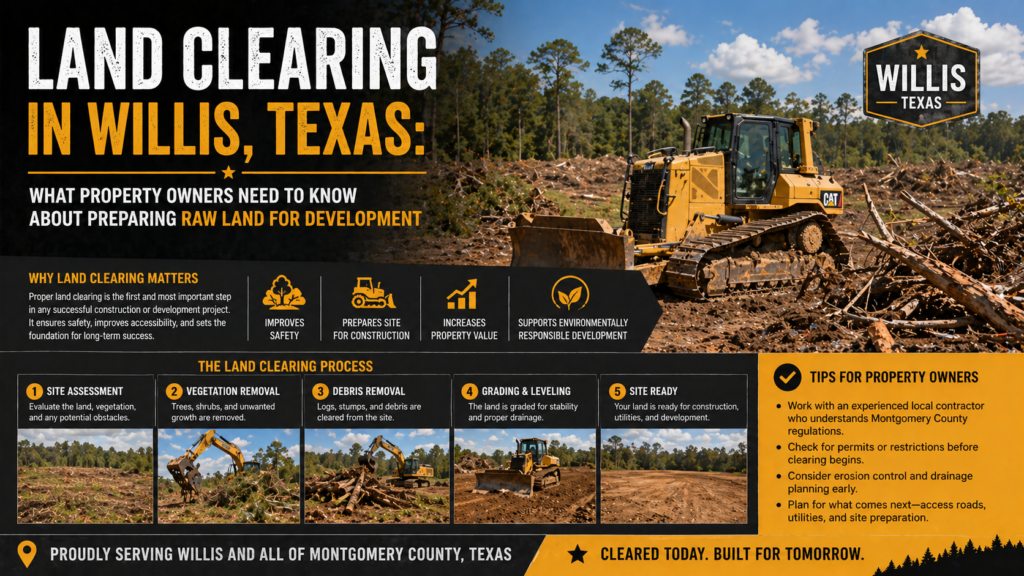
Land clearing is a broader process than simply cutting down trees. It encompasses the removal of all vegetation, organic material, and obstructions from a defined area of land, followed by preparation of the surface for its intended next use.
Tree removal and felling is typically the most visible part of land clearing in the Willis area, where properties are often covered in loblolly pine, water oak, and various understory tree species characteristic of the East Texas Piney Woods. Professional tree removal involves felling trees in a controlled manner that protects adjacent property and features, followed by bucking the trunks into manageable sections and managing the resulting material.
Brush and undergrowth removal addresses the dense vegetation that grows beneath the tree canopy in the humid subtropical climate of Southeast Texas. Dewberry, yaupon holly, wax myrtle, and other native shrubs and vines create thick understories on undeveloped land. This material must be cleared along with larger trees to create a workable site.
Stump removal or grinding is a critical step that is sometimes treated as optional but is rarely so in practice. Stumps and root systems left in the ground on a building site can cause significant problems. As root systems decompose over years, they create voids in the soil that lead to settling and subsidence a particular concern under slabs and paved surfaces. Professional stump grinding reduces stumps to below grade, and in cases where complete root removal is required, excavation removes the entire root ball.
Debris hauling or processing manages the material produced by clearing. Depending on local ordinances, the volume of material, and the property owner’s preferences, cleared vegetation may be chipped and used as ground cover, hauled away to appropriate disposal or processing facilities, or in some cases burned where permitted. In the Willis area, where burn permits are regulated and fire safety is a consideration in the dry season months, chipping and hauling is often the preferred approach.
Final grading and site preparation follows clearing, shaping the cleared surface to the required elevation and drainage pattern that will serve the site’s intended use.
The Piney Woods Environment and Its Clearing Challenges
Willis sits at the southern edge of the Sam Houston National Forest and the broader East Texas Piney Woods ecosystem. The landscape is shaped by abundant rainfall, fertile sandy-loam soils, and a warm climate that produces fast-growing, dense forest cover on any undeveloped land.
This environment creates specific challenges for land clearing that differ from clearing work in other Texas regions. The density and maturity of pine timber in the area mean that large trees with extensive root systems are common on residential-scale lots. The moist soil conditions, particularly following the heavy spring and summer rainfall events that are typical of this part of Texas, can make access difficult and create compaction risks when heavy equipment operates on wet ground.
The proximity of many Willis-area properties to drainage features the creeks, sloughs, and bayous that feed the San Jacinto watershed means that cleared areas near these features must be managed carefully to prevent sediment runoff into waterways. In Texas, clearing near regulated waterways may trigger requirements for sediment control measures, and in some cases coordination with the Army Corps of Engineers or the Texas Commission on Environmental Quality regarding jurisdictional wetland impacts.
The wildlife ecology of the East Texas forest also shapes clearing work. The area supports diverse wildlife including whitetail deer, wild turkey, various raptor species, and migratory songbirds. Timing clearing work to avoid active nesting seasons for protected species, and being mindful of hollow trees and features that may provide wildlife habitat, reflects both regulatory compliance and the environmental stewardship that responsible contractors practice.
Clearing Methods Used in the Willis Area
Multiple clearing methods are available to contractors working in the Willis area, and the appropriate method or combination of methods depends on the size and character of the site, the density and type of vegetation, the property owner’s goals, and budget considerations.
Conventional mechanical clearing using tracked bulldozers and excavators is the traditional approach for full-site clearing where all vegetation will be removed and the ground will be graded afterward. This method is efficient for large areas but results in significant soil disturbance and produces substantial volumes of material that must be managed.
Forestry mulching has become an increasingly popular alternative in the Montgomery County area, and for good reason. Forestry mulchers specialized attachments mounted on track loaders or skid steers grind trees, brush, and stumps in place, producing a layer of wood chip mulch that is left on the site. This approach is faster and less disruptive than conventional clearing, produces far less debris to manage, helps stabilize the soil surface against erosion, and can be executed with more precision and less damage to surrounding trees and features that are intended to remain. For selective clearing projects where a property owner wants to open up a site while preserving specimen trees or maintaining some natural vegetation forestry mulching is often the superior method.
Hand clearing using chainsaws and hand tools is used for areas where equipment access is limited, near structures or features that require precise clearance, or for detailed work that machine clearing cannot accomplish with sufficient precision. Hand clearing is slower and more labor-intensive than machine methods but offers the highest degree of control.
Clearing for Development vs. Clearing for Land Management
Not all land clearing in the Willis area is in preparation for construction. A significant portion of clearing work is performed for land management purposes improving pasture for livestock, managing fire risk by reducing fuel load near structures, creating hunting clearings on recreational land, or simply making overgrown property more accessible and usable without the intent of building immediately.
Land management clearing tends to be more selective and less aggressive than development clearing. The goal is often to maintain desirable trees and natural features while removing invasive species, dense brush, or hazardous dead wood. This type of clearing benefits from forestry mulching or selective hand and machine methods rather than the full-site mechanical clearing appropriate for a construction project.
Understanding the intended outcome is therefore the starting point for any land clearing engagement. A clearing contractor who begins with a thorough conversation about what the property owner wants to achieve now and in the future can recommend an approach that produces the right result rather than defaulting to the most aggressive method regardless of the situation.
Permits and Regulations for Land Clearing in Willis
Land clearing in Willis and the surrounding Montgomery County area may be subject to local tree preservation ordinances, drainage and erosion control regulations, and state and federal environmental requirements depending on the size and location of the project.
The City of Willis has its own code of ordinances that govern land disturbance activities within the city limits. Unincorporated areas of Montgomery County are subject to county regulations. Projects that disturb one acre or more of land are subject to Texas Commission on Environmental Quality stormwater permitting requirements that mandate erosion control plans and pollution prevention measures during clearing and grading activities.
An experienced land clearing contractor in the Willis area understands these regulatory requirements and incorporates compliance into how projects are planned and executed. This is not simply bureaucratic box-checking proper erosion and sediment control during land clearing actively protects downstream water quality and prevents the sedimentation problems that unconstrolled clearing runoff creates in local waterways.